
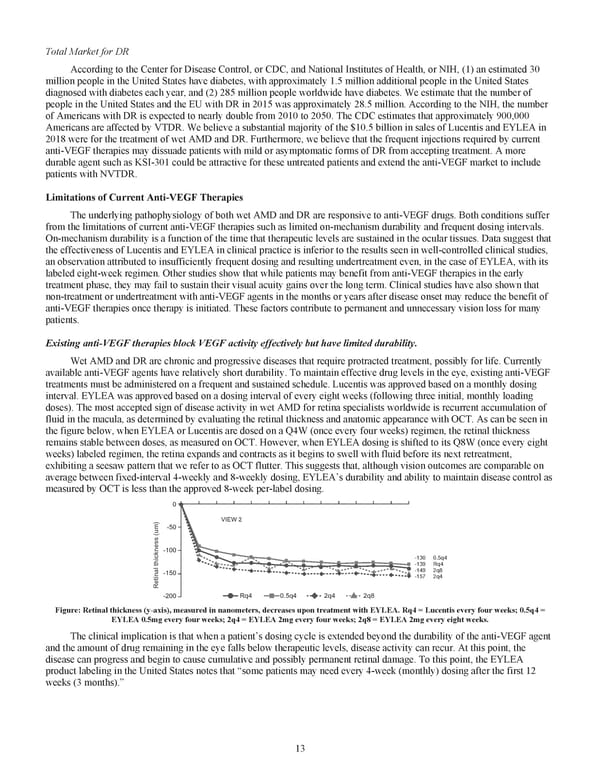
13 Total Market for DR According to the Center for Disease Control, or CDC, and National Institutes of Health, or NIH, (1) an estimated 30 million people in the United States have diabetes, with approximately 1.5 million additional people in the United States diagnosed with diabetes each year, and (2) 285 million people worldwide have diabetes. We estimate that the number of people in the United States and the EU with DR in 2015 was approximately 28.5 million. According to the NIH, the number of Americans with DR is expected to nearly double from 2010 to 2050. The CDC estimates that approximately 900,000 Americans are affected by VTDR. We believe a substantial majority of the $10.5 billion in sales of Lucentis and EYLEA in 2018 were for the treatment of wet AMD and DR. Furthermore, we believe that the frequent injections required by current anti-VEGF therapies may dissuade patients with mild or asymptomatic forms of DR from accepting treatment. A more durable agent such as KSI-301 could be attractive for these untreated patients and extend the anti-VEGF market to include patients with NVTDR. Limitations of Current Anti-VEGF Therapies The underlying pathophysiology of both wet AMD and DR are responsive to anti-VEGF drugs. Both conditions suffer from the limitations of current anti-VEGF therapies such as limited on-mechanism durability and frequent dosing intervals. On-mechanism durability is a function of the time that therapeutic levels are sustained in the ocular tissues. Data suggest that the effectiveness of Lucentis and EYLEA in clinical practice is inferior to the results seen in well-controlled clinical studies, an observation attributed to insufficiently frequent dosing and resulting undertreatment even, in the case of EYLEA, with its labeled eight-week regimen. Other studies show that while patients may benefit from anti-VEGF therapies in the early treatment phase, they may fail to sustain their visual acuity gains over the long term. Clinical studies have also shown that non-treatment or undertreatment with anti-VEGF agents in the months or years after disease onset may reduce the benefit of anti-VEGF therapies once therapy is initiated. These factors contribute to permanent and unnecessary vision loss for many patients. Existing anti-VEGF therapies block VEGF activity effectively but have limited durability. Wet AMD and DR are chronic and progressive diseases that require protracted treatment, possibly for life. Currently available anti-VEGF agents have relatively short durability. To maintain effective drug levels in the eye, existing anti-VEGF treatments must be administered on a frequent and sustained schedule. Lucentis was approved based on a monthly dosing interval. EYLEA was approved based on a dosing interval of every eight weeks (following three initial, monthly loading doses). The most accepted sign of disease activity in wet AMD for retina specialists worldwide is recurrent accumulation of fluid in the macula, as determined by evaluating the retinal thickness and anatomic appearance with OCT. As can be seen in the figure below, when EYLEA or Lucentis are dosed on a Q4W (once every four weeks) regimen, the retinal thickness remains stable between doses, as measured on OCT. However, when EYLEA dosing is shifted to its Q8W (once every eight weeks) labeled regimen, the retina expands and contracts as it begins to swell with fluid before its next retreatment, exhibiting a seesaw pattern that we refer to as OCT flutter. This suggests that, although vision outcomes are comparable on average between fixed-interval 4-weekly and 8-weekly dosing, EYLEA’s durability and ability to maintain disease control as measured by OCT is less than the approved 8-week per-label dosing. Figure: Retinal thickness (y-axis), measured in nanometers, decreases upon treatment with EYLEA. Rq4 = Lucentis every four weeks; 0.5q4 = EYLEA 0.5mg every four weeks; 2q4 = EYLEA 2mg every four weeks; 2q8 = EYLEA 2mg every eight weeks. The clinical implication is that when a patient’s dosing cycle is extended beyond the durability of the anti-VEGF agent and the amount of drug remaining in the eye falls below therapeutic levels, disease activity can recur. At this point, the disease can progress and begin to cause cumulative and possibly permanent retinal damage. To this point, the EYLEA product labeling in the United States notes that “some patients may need every 4-week (monthly) dosing after the first 12 weeks (3 months).” -130 0.5q4 -139 Rq4 -149 2q8 -157 2q4 VIEW 2 Rq4 0.5q4 2q4 2q8 0 -50 -100 -150 -200 Retinal thickness (um)
 Kodiak 2018 Annual Report Page 24 Page 26