
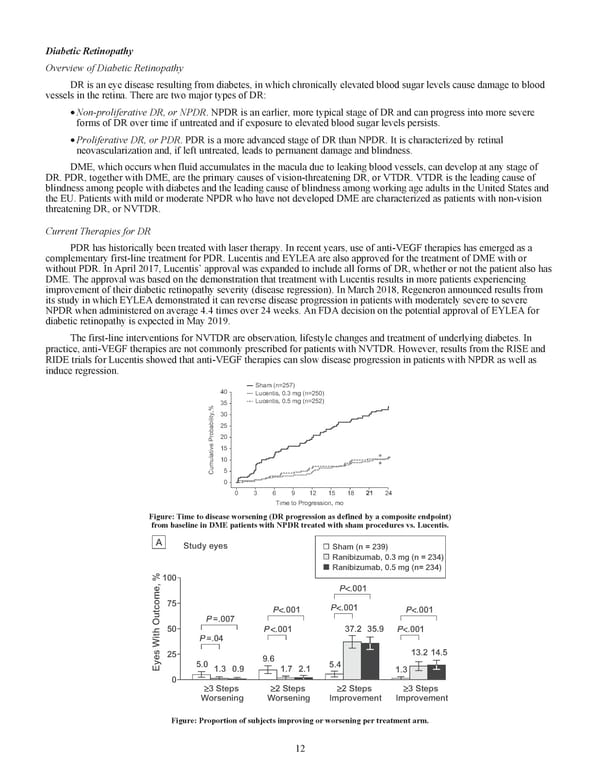
12 Diabetic Retinopathy Overview of Diabetic Retinopathy DR is an eye disease resulting from diabetes, in which chronically elevated blood sugar levels cause damage to blood vessels in the retina. There are two major types of DR: • Non-proliferative DR, or NPDR. NPDR is an earlier, more typical stage of DR and can progress into more severe forms of DR over time if untreated and if exposure to elevated blood sugar levels persists. • Proliferative DR, or PDR. PDR is a more advanced stage of DR than NPDR. It is characterized by retinal neovascularization and, if left untreated, leads to permanent damage and blindness. DME, which occurs when fluid accumulates in the macula due to leaking blood vessels, can develop at any stage of DR. PDR, together with DME, are the primary causes of vision-threatening DR, or VTDR. VTDR is the leading cause of blindness among people with diabetes and the leading cause of blindness among working age adults in the United States and the EU. Patients with mild or moderate NPDR who have not developed DME are characterized as patients with non-vision threatening DR, or NVTDR. Current Therapies for DR PDR has historically been treated with laser therapy. In recent years, use of anti-VEGF therapies has emerged as a complementary first-line treatment for PDR. Lucentis and EYLEA are also approved for the treatment of DME with or without PDR. In April 2017, Lucentis’ approval was expanded to include all forms of DR, whether or not the patient also has DME. The approval was based on the demonstration that treatment with Lucentis results in more patients experiencing improvement of their diabetic retinopathy severity (disease regression). In March 2018, Regeneron announced results from its study in which EYLEA demonstrated it can reverse disease progression in patients with moderately severe to severe NPDR when administered on average 4.4 times over 24 weeks. An FDA decision on the potential approval of EYLEA for diabetic retinopathy is expected in May 2019. The first-line interventions for NVTDR are observation, lifestyle changes and treatment of underlying diabetes. In practice, anti-VEGF therapies are not commonly prescribed for patients with NVTDR. However, results from the RISE and RIDE trials for Lucentis showed that anti-VEGF therapies can slow disease progression in patients with NPDR as well as induce regression. Figure: Time to disease worsening (DR progression as defined by a composite endpoint) from baseline in DME patients with NPDR treated with sham procedures vs. Lucentis. Figure: Proportion of subjects improving or worsening per treatment arm. 40 30 35 10 15 20 25 5 0 0 6 12 15 18 24 21 Time to Progression, mo Cumulative Probability,% Sham (n=257) Lucentis, 0.5 mg (n=252) Lucentis, 0.3 mg (n=250) 9 3 5.0 1.3 0.9 9.6 5.4 1.3 37.2 35.9 13.2 14.5 1.7 2.1 P =.04 P =.007 P .001 P .001 P .001 P .001 P .001 P .001 100 50 75 25 0 3 Steps Worsening Study eyes 2 Steps Worsening 2 Steps Improvement 3 Steps Improvement Eyes With Outcome, % A Sham (n = 239) Ranibizumab, 0.3 mg (n = 234) Ranibizumab, 0.5 mg (n= 234)
 Kodiak 2018 Annual Report Page 23 Page 25