
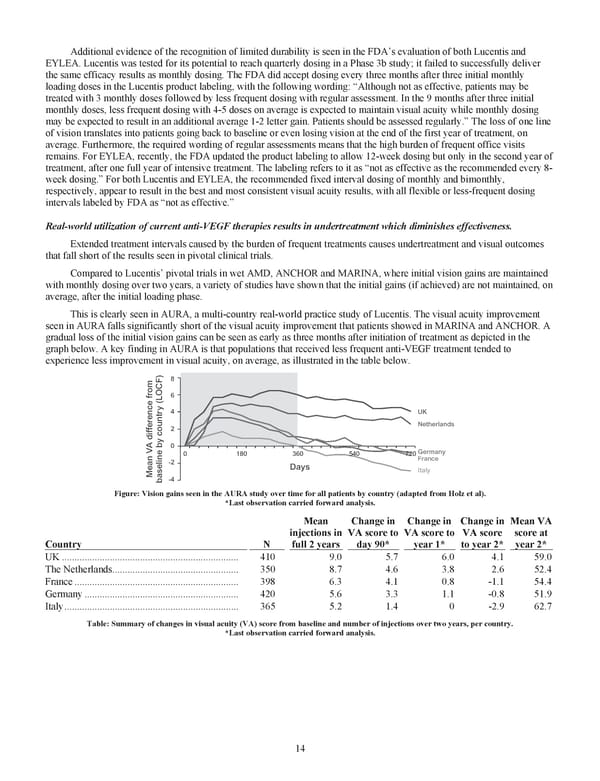
14 Additional evidence of the recognition of limited durability is seen in the FDA’s evaluation of both Lucentis and EYLEA. Lucentis was tested for its potential to reach quarterly dosing in a Phase 3b study; it failed to successfully deliver the same efficacy results as monthly dosing. The FDA did accept dosing every three months after three initial monthly loading doses in the Lucentis product labeling, with the following wording: “Although not as effective, patients may be treated with 3 monthly doses followed by less frequent dosing with regular assessment. In the 9 months after three initial monthly doses, less frequent dosing with 4-5 doses on average is expected to maintain visual acuity while monthly dosing may be expected to result in an additional average 1-2 letter gain. Patients should be assessed regularly.” The loss of one line of vision translates into patients going back to baseline or even losing vision at the end of the first year of treatment, on average. Furthermore, the required wording of regular assessments means that the high burden of frequent office visits remains. For EYLEA, recently, the FDA updated the product labeling to allow 12-week dosing but only in the second year of treatment, after one full year of intensive treatment. The labeling refers to it as “not as effective as the recommended every 8- week dosing.” For both Lucentis and EYLEA, the recommended fixed interval dosing of monthly and bimonthly, respectively, appear to result in the best and most consistent visual acuity results, with all flexible or less-frequent dosing intervals labeled by FDA as “not as effective.” Real-world utilization of current anti-VEGF therapies results in undertreatment which diminishes effectiveness. Extended treatment intervals caused by the burden of frequent treatments causes undertreatment and visual outcomes that fall short of the results seen in pivotal clinical trials. Compared to Lucentis’ pivotal trials in wet AMD, ANCHOR and MARINA, where initial vision gains are maintained with monthly dosing over two years, a variety of studies have shown that the initial gains (if achieved) are not maintained, on average, after the initial loading phase. This is clearly seen in AURA, a multi-country real-world practice study of Lucentis. The visual acuity improvement seen in AURA falls significantly short of the visual acuity improvement that patients showed in MARINA and ANCHOR. A gradual loss of the initial vision gains can be seen as early as three months after initiation of treatment as depicted in the graph below. A key finding in AURA is that populations that received less frequent anti-VEGF treatment tended to experience less improvement in visual acuity, on average, as illustrated in the table below. Figure: Vision gains seen in the AURA study over time for all patients by country (adapted from Holz et al). *Last observation carried forward analysis. Country N Mean injections in full 2 years Change in VA score to day 90* Change in VA score to year 1* Change in VA score to year 2* Mean VA score at year 2* UK ...................................................................... 410 9.0 5.7 6.0 4.1 59.0 The Netherlands.................................................. 350 8.7 4.6 3.8 2.6 52.4 France ................................................................. 398 6.3 4.1 0.8 -1.1 54.4 Germany ............................................................. 420 5.6 3.3 1.1 -0.8 51.9 Italy..................................................................... 365 5.2 1.4 0 -2.9 62.7 Table: Summary of changes in visual acuity (VA) score from baseline and number of injections over two years, per country. *Last observation carried forward analysis. -4 -2 0 2 4 6 8 0 180 360 540 54 720 72 72 Days Mean VA difference from baseline by country (LOCF) UK Netherlands Germany France Italy
 Kodiak 2018 Annual Report Page 25 Page 27