
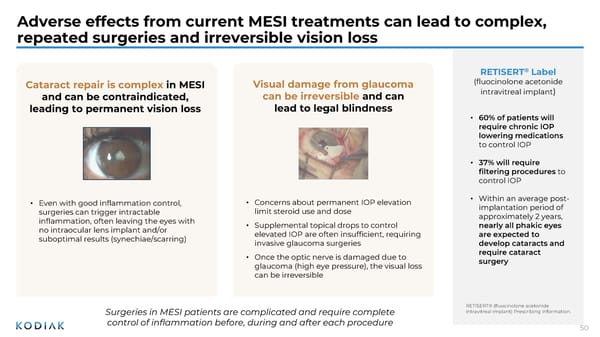
Adverse effects from current MESI treatments can lead to complex, repeated surgeries and irreversible vision loss Surgeries in MESI patients are complicated and require complete control of inflammation before, during and after each procedure • Even with good inflammation control, surgeries can trigger intractable inflammation, often leaving the eyes with no intraocular lens implant and/or suboptimal results (synechiae/scarring) Visual damage from glaucoma can be irreversible and can lead to legal blindness • Concerns about permanent IOP elevation limit steroid use and dose • Supplemental topical drops to control elevated IOP are often insufficient, requiring invasive glaucoma surgeries • Once the optic nerve is damaged due to glaucoma (high eye pressure), the visual loss can be irreversible Cataract repair is complex in MESI and can be contraindicated, leading to permanent vision loss RETISERT ® Label (fluocinolone acetonide intravitreal implant ) • 60% of patients will require chronic IOP lowering medications to control IOP • 37% will require filtering procedures to control IOP • Within an average post- implantation period of approximately 2 years, nearly all phakic eyes are expected to develop cataracts and require cataract surgery RETISERT® (fluocinolone acetonide intravitreal implant) Prescribing Information. 50
 Interactive Corporate Presentation Page 49 Page 51