
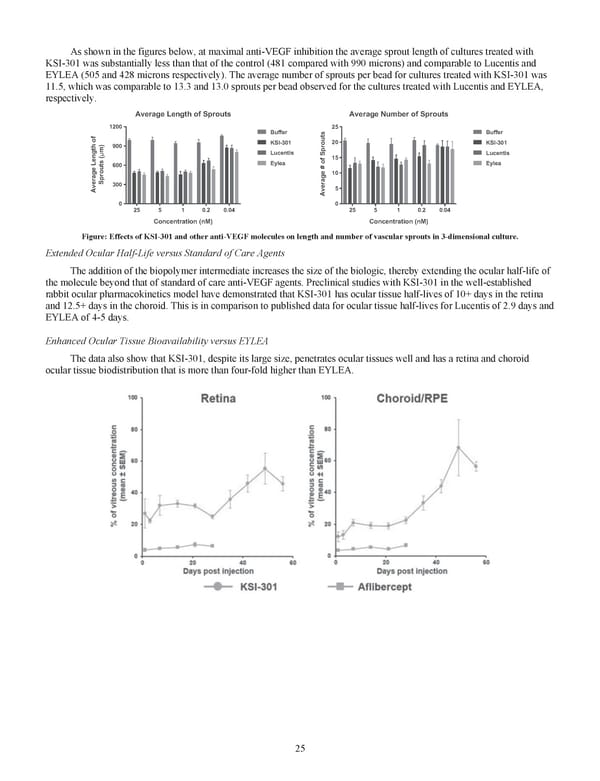
25 As shown in the figures below, at maximal anti-VEGF inhibition the average sprout length of cultures treated with KSI-301 was substantially less than that of the control (481 compared with 990 microns) and comparable to Lucentis and EYLEA (505 and 428 microns respectively). The average number of sprouts per bead for cultures treated with KSI-301 was 11.5, which was comparable to 13.3 and 13.0 sprouts per bead observed for the cultures treated with Lucentis and EYLEA, respectively. Figure: Effects of KSI-301 and other anti-VEGF molecules on length and number of vascular sprouts in 3-dimensional culture. Extended Ocular Half-Life versus Standard of Care Agents The addition of the biopolymer intermediate increases the size of the biologic, thereby extending the ocular half-life of the molecule beyond that of standard of care anti-VEGF agents. Preclinical studies with KSI-301 in the well-established rabbit ocular pharmacokinetics model have demonstrated that KSI-301 has ocular tissue half-lives of 10+ days in the retina and 12.5+ days in the choroid. This is in comparison to published data for ocular tissue half-lives for Lucentis of 2.9 days and EYLEA of 4-5 days. Enhanced Ocular Tissue Bioavailability versus EYLEA The data also show that KSI-301, despite its large size, penetrates ocular tissues well and has a retina and choroid ocular tissue biodistribution that is more than four-fold higher than EYLEA. 25 0.2 0.04 0 5 10 15 20 25 Concentration (nM) Average # of Sprouts Buffer KSI-301 Lucentis Eylea Average Number of Sprouts Buffer KSI-301 Lucentis Eylea 0 300 600 900 1200 Average Length of Sprouts Concentration (nM) Average Length of Sprouts (μm) 25 5 0.2 0.04 1 5 1
 Kodiak 2018 Annual Report Page 36 Page 38