
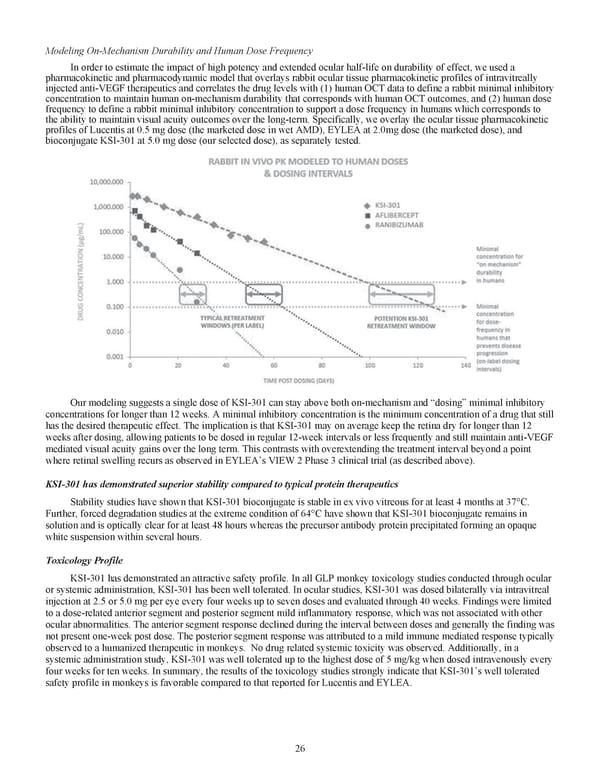
26 Modeling On-Mechanism Durability and Human Dose Frequency In order to estimate the impact of high potency and extended ocular half-life on durability of effect, we used a pharmacokinetic and pharmacodynamic model that overlays rabbit ocular tissue pharmacokinetic profiles of intravitreally injected anti-VEGF therapeutics and correlates the drug levels with (1) human OCT data to define a rabbit minimal inhibitory concentration to maintain human on-mechanism durability that corresponds with human OCT outcomes, and (2) human dose frequency to define a rabbit minimal inhibitory concentration to support a dose frequency in humans which corresponds to the ability to maintain visual acuity outcomes over the long-term. Specifically, we overlay the ocular tissue pharmacokinetic profiles of Lucentis at 0.5 mg dose (the marketed dose in wet AMD), EYLEA at 2.0mg dose (the marketed dose), and bioconjugate KSI-301 at 5.0 mg dose (our selected dose), as separately tested. Our modeling suggests a single dose of KSI-301 can stay above both on-mechanism and “dosing” minimal inhibitory concentrations for longer than 12 weeks. A minimal inhibitory concentration is the minimum concentration of a drug that still has the desired therapeutic effect. The implication is that KSI-301 may on average keep the retina dry for longer than 12 weeks after dosing, allowing patients to be dosed in regular 12-week intervals or less frequently and still maintain anti-VEGF mediated visual acuity gains over the long term. This contrasts with overextending the treatment interval beyond a point where retinal swelling recurs as observed in EYLEA’s VIEW 2 Phase 3 clinical trial (as described above). KSI-301 has demonstrated superior stability compared to typical protein therapeutics Stability studies have shown that KSI-301 bioconjugate is stable in ex vivo vitreous for at least 4 months at 37°C. Further, forced degradation studies at the extreme condition of 64°C have shown that KSI-301 bioconjugate remains in solution and is optically clear for at least 48 hours whereas the precursor antibody protein precipitated forming an opaque white suspension within several hours. Toxicology Profile KSI-301 has demonstrated an attractive safety profile. In all GLP monkey toxicology studies conducted through ocular or systemic administration, KSI-301 has been well tolerated. In ocular studies, KSI-301 was dosed bilaterally via intravitreal injection at 2.5 or 5.0 mg per eye every four weeks up to seven doses and evaluated through 40 weeks. Findings were limited to a dose-related anterior segment and posterior segment mild inflammatory response, which was not associated with other ocular abnormalities. The anterior segment response declined during the interval between doses and generally the finding was not present one-week post dose. The posterior segment response was attributed to a mild immune mediated response typically observed to a humanized therapeutic in monkeys. No drug related systemic toxicity was observed. Additionally, in a systemic administration study, KSI-301 was well tolerated up to the highest dose of 5 mg/kg when dosed intravenously every four weeks for ten weeks. In summary, the results of the toxicology studies strongly indicate that KSI-301’s well tolerated safety profile in monkeys is favorable compared to that reported for Lucentis and EYLEA.
 Kodiak 2018 Annual Report Page 37 Page 39