
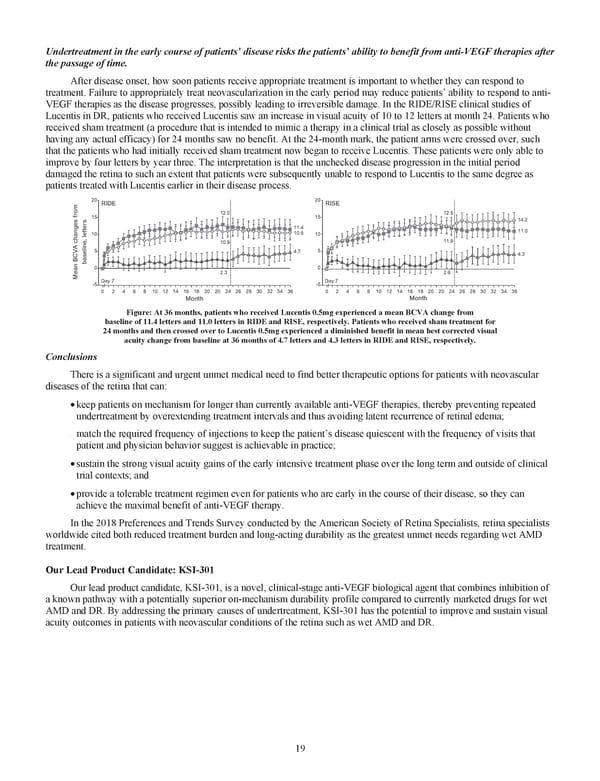
19 Undertreatment in the early course of patients’ disease risks the patients’ ability to benefit from anti-VEGF therapies after the passage of time. After disease onset, how soon patients receive appropriate treatment is important to whether they can respond to treatment. Failure to appropriately treat neovascularization in the early period may reduce patients’ ability to respond to anti- VEGF therapies as the disease progresses, possibly leading to irreversible damage. In the RIDE/RISE clinical studies of Lucentis in DR, patients who received Lucentis saw an increase in visual acuity of 10 to 12 letters at month 24. Patients who received sham treatment (a procedure that is intended to mimic a therapy in a clinical trial as closely as possible without having any actual efficacy) for 24 months saw no benefit. At the 24-month mark, the patient arms were crossed over, such that the patients who had initially received sham treatment now began to receive Lucentis. These patients were only able to improve by four letters by year three. The interpretation is that the unchecked disease progression in the initial period damaged the retina to such an extent that patients were subsequently unable to respond to Lucentis to the same degree as patients treated with Lucentis earlier in their disease process. Figure: At 36 months, patients who received Lucentis 0.5mg experienced a mean BCVA change from baseline of 11.4 letters and 11.0 letters in RIDE and RISE, respectively. Patients who received sham treatment for 24 months and then crossed over to Lucentis 0.5mg experienced a diminished benefit in mean best corrected visual acuity change from baseline at 36 months of 4.7 letters and 4.3 letters in RIDE and RISE, respectively. Conclusions There is a significant and urgent unmet medical need to find better therapeutic options for patients with neovascular diseases of the retina that can: • keep patients on mechanism for longer than currently available anti-VEGF therapies, thereby preventing repeated undertreatment by overextending treatment intervals and thus avoiding latent recurrence of retinal edema; • match the required frequency of injections to keep the patient’s disease quiescent with the frequency of visits that patient and physician behavior suggest is achievable in practice; • sustain the strong visual acuity gains of the early intensive treatment phase over the long term and outside of clinical trial contexts; and • provide a tolerable treatment regimen even for patients who are early in the course of their disease, so they can achieve the maximal benefit of anti-VEGF therapy. In the 2018 Preferences and Trends Survey conducted by the American Society of Retina Specialists, retina specialists worldwide cited both reduced treatment burden and long-acting durability as the greatest unmet needs regarding wet AMD treatment. Our Lead Product Candidate: KSI-301 Our lead product candidate, KSI-301, is a novel, clinical-stage anti-VEGF biological agent that combines inhibition of a known pathway with a potentially superior on-mechanism durability profile compared to currently marketed drugs for wet AMD and DR. By addressing the primary causes of undertreatment, KSI-301 has the potential to improve and sustain visual acuity outcomes in patients with neovascular conditions of the retina such as wet AMD and DR. Month 12.0 11.4 10.6 4.7 10.9 2.3 12.5 Day 7 11.9 2.6 14.2 11.0 4.3 RIDE Month 0 2 4 6 8 10 12 14 16 18 20 20 24 26 28 30 32 34 36 0 2 4 6 8 10 12 14 16 18 20 20 24 26 28 30 32 34 36 20 15 10 5 0 -5 20 15 10 5 0 -5 RISE Mean BCVA changes from baseline, letters Day 7
 Kodiak 2018 Annual Report Page 30 Page 32