
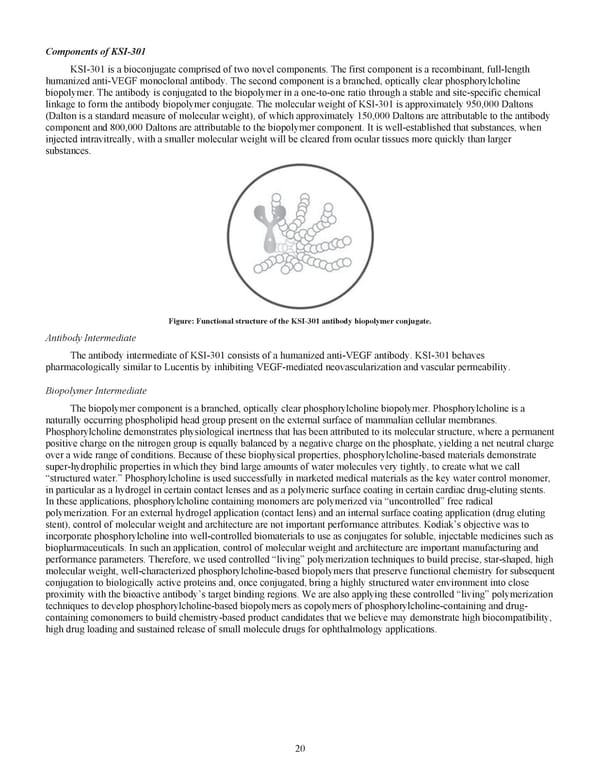
20 Components of KSI-301 KSI-301 is a bioconjugate comprised of two novel components. The first component is a recombinant, full-length humanized anti-VEGF monoclonal antibody. The second component is a branched, optically clear phosphorylcholine biopolymer. The antibody is conjugated to the biopolymer in a one-to-one ratio through a stable and site-specific chemical linkage to form the antibody biopolymer conjugate. The molecular weight of KSI-301 is approximately 950,000 Daltons (Dalton is a standard measure of molecular weight), of which approximately 150,000 Daltons are attributable to the antibody component and 800,000 Daltons are attributable to the biopolymer component. It is well-established that substances, when injected intravitreally, with a smaller molecular weight will be cleared from ocular tissues more quickly than larger substances. Figure: Functional structure of the KSI-301 antibody biopolymer conjugate. Antibody Intermediate The antibody intermediate of KSI-301 consists of a humanized anti-VEGF antibody. KSI-301 behaves pharmacologically similar to Lucentis by inhibiting VEGF-mediated neovascularization and vascular permeability. Biopolymer Intermediate The biopolymer component is a branched, optically clear phosphorylcholine biopolymer. Phosphorylcholine is a naturally occurring phospholipid head group present on the external surface of mammalian cellular membranes. Phosphorylcholine demonstrates physiological inertness that has been attributed to its molecular structure, where a permanent positive charge on the nitrogen group is equally balanced by a negative charge on the phosphate, yielding a net neutral charge over a wide range of conditions. Because of these biophysical properties, phosphorylcholine-based materials demonstrate super-hydrophilic properties in which they bind large amounts of water molecules very tightly, to create what we call “structured water.” Phosphorylcholine is used successfully in marketed medical materials as the key water control monomer, in particular as a hydrogel in certain contact lenses and as a polymeric surface coating in certain cardiac drug-eluting stents. In these applications, phosphorylcholine containing monomers are polymerized via “uncontrolled” free radical polymerization. For an external hydrogel application (contact lens) and an internal surface coating application (drug eluting stent), control of molecular weight and architecture are not important performance attributes. Kodiak’s objective was to incorporate phosphorylcholine into well-controlled biomaterials to use as conjugates for soluble, injectable medicines such as biopharmaceuticals. In such an application, control of molecular weight and architecture are important manufacturing and performance parameters. Therefore, we used controlled “living” polymerization techniques to build precise, star-shaped, high molecular weight, well-characterized phosphorylcholine-based biopolymers that preserve functional chemistry for subsequent conjugation to biologically active proteins and, once conjugated, bring a highly structured water environment into close proximity with the bioactive antibody’s target binding regions. We are also applying these controlled “living” polymerization techniques to develop phosphorylcholine-based biopolymers as copolymers of phosphorylcholine-containing and drug- containing comonomers to build chemistry-based product candidates that we believe may demonstrate high biocompatibility, high drug loading and sustained release of small molecule drugs for ophthalmology applications.
 Kodiak 2018 Annual Report Page 31 Page 33