
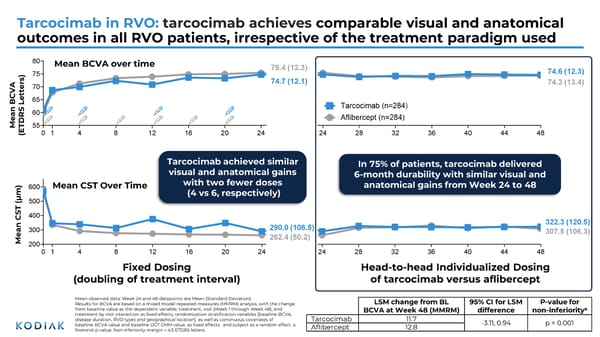
Tarcocimab in RVO: tarcocimab achieves comparable visual and anatomical outcomes in all RVO patients, irrespective of the treatment paradigm used Mean observed data; Week 24 and 48 datapoints are Mean (Standard Deviation). Results for BCVA are based on a mixed model repeated measures (MMRM) analysis, with the change from baseline value as the dependent variable; treatment, visit (Week 1 through Week 48), and treatment by visit interaction as fixed effects; randomization stratification variables [baseline BCVA, disease duration, RVO type) and geographical location], as well as continuous covariates of baseline BCVA value and baseline OCT CMM value, as fixed effects; and subject as a random effect. a. Nominal p-value. Non-inferiority margin = 4.5 ETDRS letters. 290.0 (106.5) 262.4 (50.2) 74.6 (12.3) 74.3 (13.4) 74.7 (12.1) 75.4 (12.3) 322.3 (120.5) 307.5 (106.3) 0 4 8 12 16 20 24 55 60 65 70 75 80 1 24 28 32 36 40 44 48 0 4 8 12 16 20 24 200 300 400 500 600 1 24 28 32 36 40 44 48 Mean CST Over Time Mean BCVA over time Mean BCVA (ETDRS Letters) Mean CST (μm) Head-to-head Individualized Dosing of tarcocimab versus aflibercept Fixed Dosing (doubling of treatment interval) 28 In 75% of patients, tarcocimab delivered 6-month durability with similar visual and anatomical gains from Week 24 to 48 LSM change from BL BCVA at Week 48 (MMRM) 95% CI for LSM difference P-value for non-inferiority a Tarcocimab 11.7 -3.11, 0.94 p = 0.001 Aflibercept 12.8 Tarcocimab achieved similar visual and anatomical gains with two fewer doses (4 vs 6, respectively)
 Presentation at Jefferies Global Healthcare Conference Page 27 Page 29