
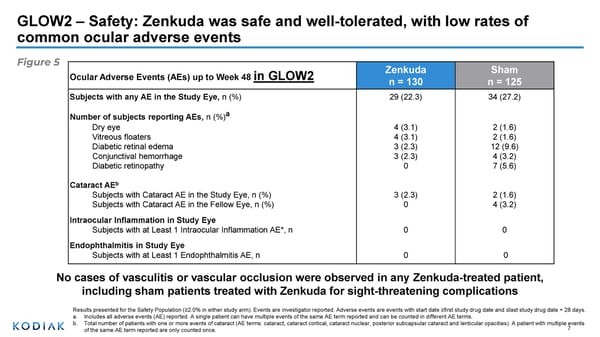
GLOW2 – Safety: Zenkuda was safe and well-tolerated, with low rates of common ocular adverse events Ocular Adverse Events (AEs) up to Week 48 in GLOW2 Zenkuda n = 130 Sham n = 125 Subjects with any AE in the Study Eye, n (%) 29 (22.3) 34 (27.2) Number of subjects reporting AEs, n (%) a Dry eye 4 (3.1) 2 (1.6) Vitreous floaters 4 (3.1) 2 (1.6) Diabetic retinal edema 3 (2.3) 12 (9.6) Conjunctival hemorrhage 3 (2.3) 4 (3.2) Diabetic retinopathy 0 7 (5.6) Cataract AE b Subjects with Cataract AE in the Study Eye, n (%) 3 (2.3) 2 (1.6) Subjects with Cataract AE in the Fellow Eye, n (%) 0 4 (3.2) Intraocular Inflammation in Study Eye Subjects with at Least 1 Intraocular Inflammation AE*, n 0 0 Endophthalmitis in Study Eye Subjects with at Least 1 Endophthalmitis AE, n 0 0 No cases of vasculitis or vascular occlusion were observed in any Zenkuda-treated patient, including sham patients treated with Zenkuda for sight-threatening complications Results presented for the Safety Population (≥2.0% in either study arm). Events are investigator reported. Adverse events are events with start date ≥first study drug date and ≤last study drug date + 28 days. a. Includes all adverse events (AE) reported. A single patient can have multiple events of the same AE term reported and can be counted in different AE terms. b. Total number of patients with one or more events of cataract (AE terms: cataract, cataract cortical, cataract nuclear, posterior subcapsular cataract and lenticular opacities). A patient with multiple events of the same AE term reported are only counted once. 7 Figure 5
 Phase 3 Study Results of Zenkuda™ in Diabetic Retinopathy Page 6 Page 8