
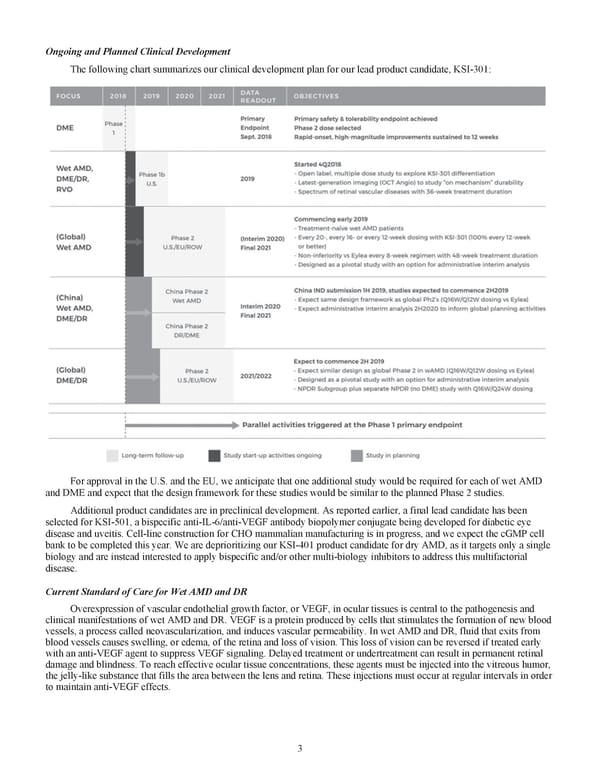
3 Ongoing and Planned Clinical Development The following chart summarizes our clinical development plan for our lead product candidate, KSI-301: For approval in the U.S. and the EU, we anticipate that one additional study would be required for each of wet AMD and DME and expect that the design framework for these studies would be similar to the planned Phase 2 studies. Additional product candidates are in preclinical development. As reported earlier, a final lead candidate has been selected for KSI-501, a bispecific anti-IL-6/anti-VEGF antibody biopolymer conjugate being developed for diabetic eye disease and uveitis. Cell-line construction for CHO mammalian manufacturing is in progress, and we expect the cGMP cell bank to be completed this year. We are deprioritizing our KSI-401 product candidate for dry AMD, as it targets only a single biology and are instead interested to apply bispecific and/or other multi-biology inhibitors to address this multifactorial disease. Current Standard of Care for Wet AMD and DR Overexpression of vascular endothelial growth factor, or VEGF, in ocular tissues is central to the pathogenesis and clinical manifestations of wet AMD and DR. VEGF is a protein produced by cells that stimulates the formation of new blood vessels, a process called neovascularization, and induces vascular permeability. In wet AMD and DR, fluid that exits from blood vessels causes swelling, or edema, of the retina and loss of vision. This loss of vision can be reversed if treated early with an anti-VEGF agent to suppress VEGF signaling. Delayed treatment or undertreatment can result in permanent retinal damage and blindness. To reach effective ocular tissue concentrations, these agents must be injected into the vitreous humor, the jelly-like substance that fills the area between the lens and retina. These injections must occur at regular intervals in order to maintain anti-VEGF effects.
 Kodiak 2018 Annual Report Page 14 Page 16