
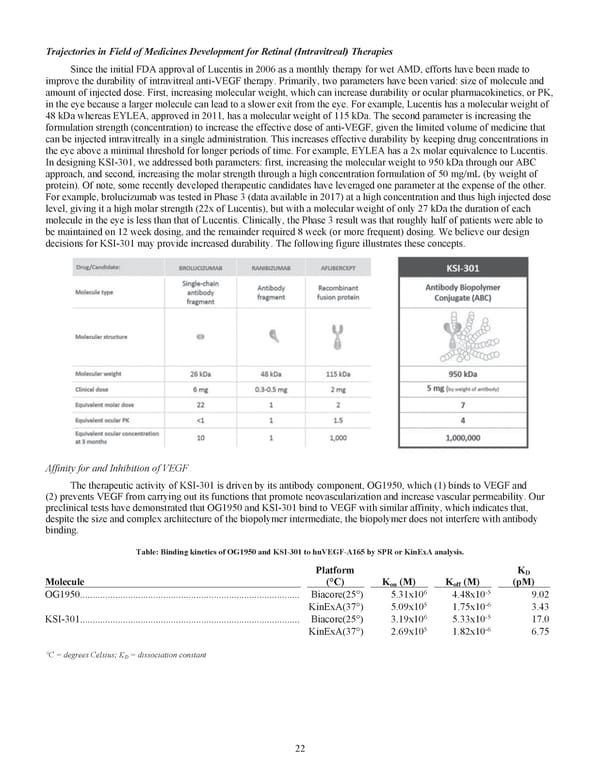
22 Trajectories in Field of Medicines Development for Retinal (Intravitreal) Therapies Since the initial FDA approval of Lucentis in 2006 as a monthly therapy for wet AMD, efforts have been made to improve the durability of intravitreal anti-VEGF therapy. Primarily, two parameters have been varied: size of molecule and amount of injected dose. First, increasing molecular weight, which can increase durability or ocular pharmacokinetics, or PK, in the eye because a larger molecule can lead to a slower exit from the eye. For example, Lucentis has a molecular weight of 48 kDa whereas EYLEA, approved in 2011, has a molecular weight of 115 kDa. The second parameter is increasing the formulation strength (concentration) to increase the effective dose of anti-VEGF, given the limited volume of medicine that can be injected intravitreally in a single administration. This increases effective durability by keeping drug concentrations in the eye above a minimal threshold for longer periods of time. For example, EYLEA has a 2x molar equivalence to Lucentis. In designing KSI-301, we addressed both parameters: first, increasing the molecular weight to 950 kDa through our ABC approach, and second, increasing the molar strength through a high concentration formulation of 50 mg/mL (by weight of protein). Of note, some recently developed therapeutic candidates have leveraged one parameter at the expense of the other. For example, brolucizumab was tested in Phase 3 (data available in 2017) at a high concentration and thus high injected dose level, giving it a high molar strength (22x of Lucentis), but with a molecular weight of only 27 kDa the duration of each molecule in the eye is less than that of Lucentis. Clinically, the Phase 3 result was that roughly half of patients were able to be maintained on 12 week dosing, and the remainder required 8 week (or more frequent) dosing. We believe our design decisions for KSI-301 may provide increased durability. The following figure illustrates these concepts. Affinity for and Inhibition of VEGF The therapeutic activity of KSI-301 is driven by its antibody component, OG1950, which (1) binds to VEGF and (2) prevents VEGF from carrying out its functions that promote neovascularization and increase vascular permeability. Our preclinical tests have demonstrated that OG1950 and KSI-301 bind to VEGF with similar affinity, which indicates that, despite the size and complex architecture of the biopolymer intermediate, the biopolymer does not interfere with antibody binding. Table: Binding kinetics of OG1950 and KSI-301 to huVEGF-A165 by SPR or KinExA analysis. Molecule Platform (°C) Kon (M) Koff (M) KD (pM) OG1950....................................................................................... Biacore(25°) 5.31x10⁶ 4.48x10⁻⁵ 9.02 KinExA(37°) 5.09x10⁵ 1.75x10⁻⁶ 3.43 KSI-301....................................................................................... Biacore(25°) 3.19x10⁶ 5.33x10⁻⁵ 17.0 KinExA(37°) 2.69x10⁵ 1.82x10⁻⁶ 6.75 °C = degrees Celsius; KD = dissociation constant
 Kodiak 2018 Annual Report Page 33 Page 35