
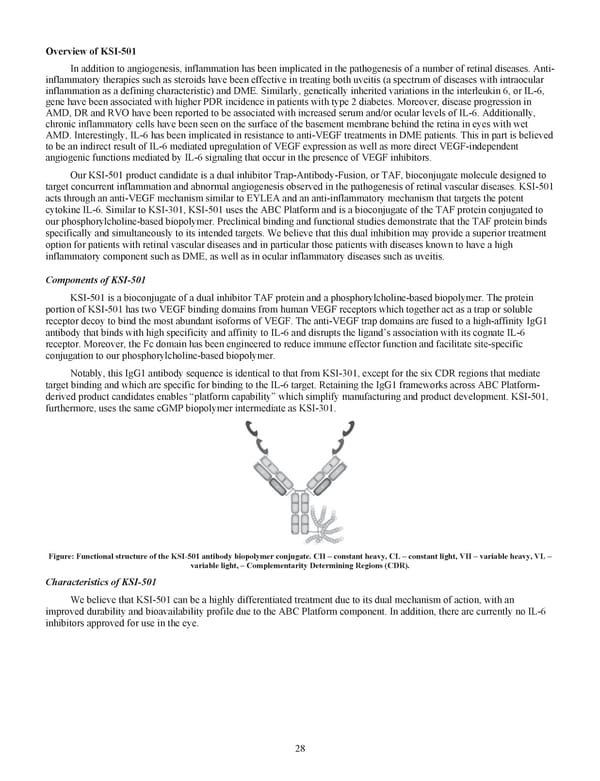
28 Overview of KSI-501 In addition to angiogenesis, inflammation has been implicated in the pathogenesis of a number of retinal diseases. Anti- inflammatory therapies such as steroids have been effective in treating both uveitis (a spectrum of diseases with intraocular inflammation as a defining characteristic) and DME. Similarly, genetically inherited variations in the interleukin 6, or IL-6, gene have been associated with higher PDR incidence in patients with type 2 diabetes. Moreover, disease progression in AMD, DR and RVO have been reported to be associated with increased serum and/or ocular levels of IL-6. Additionally, chronic inflammatory cells have been seen on the surface of the basement membrane behind the retina in eyes with wet AMD. Interestingly, IL-6 has been implicated in resistance to anti-VEGF treatments in DME patients. This in part is believed to be an indirect result of IL-6 mediated upregulation of VEGF expression as well as more direct VEGF-independent angiogenic functions mediated by IL-6 signaling that occur in the presence of VEGF inhibitors. Our KSI-501 product candidate is a dual inhibitor Trap-Antibody-Fusion, or TAF, bioconjugate molecule designed to target concurrent inflammation and abnormal angiogenesis observed in the pathogenesis of retinal vascular diseases. KSI-501 acts through an anti-VEGF mechanism similar to EYLEA and an anti-inflammatory mechanism that targets the potent cytokine IL-6. Similar to KSI-301, KSI-501 uses the ABC Platform and is a bioconjugate of the TAF protein conjugated to our phosphorylcholine-based biopolymer. Preclinical binding and functional studies demonstrate that the TAF protein binds specifically and simultaneously to its intended targets. We believe that this dual inhibition may provide a superior treatment option for patients with retinal vascular diseases and in particular those patients with diseases known to have a high inflammatory component such as DME, as well as in ocular inflammatory diseases such as uveitis. Components of KSI-501 KSI-501 is a bioconjugate of a dual inhibitor TAF protein and a phosphorylcholine-based biopolymer. The protein portion of KSI-501 has two VEGF binding domains from human VEGF receptors which together act as a trap or soluble receptor decoy to bind the most abundant isoforms of VEGF. The anti-VEGF trap domains are fused to a high-affinity IgG1 antibody that binds with high specificity and affinity to IL-6 and disrupts the ligand’s association with its cognate IL-6 receptor. Moreover, the Fc domain has been engineered to reduce immune effector function and facilitate site-specific conjugation to our phosphorylcholine-based biopolymer. Notably, this IgG1 antibody sequence is identical to that from KSI-301, except for the six CDR regions that mediate target binding and which are specific for binding to the IL-6 target. Retaining the IgG1 frameworks across ABC Platform- derived product candidates enables “platform capability” which simplify manufacturing and product development. KSI-501, furthermore, uses the same cGMP biopolymer intermediate as KSI-301. Figure: Functional structure of the KSI-501 antibody biopolymer conjugate. CH – constant heavy, CL – constant light, VH – variable heavy, VL – variable light, – Complementarity Determining Regions (CDR). Characteristics of KSI-501 We believe that KSI-501 can be a highly differentiated treatment due to its dual mechanism of action, with an improved durability and bioavailability profile due to the ABC Platform component. In addition, there are currently no IL-6 inhibitors approved for use in the eye.
 Kodiak 2018 Annual Report Page 39 Page 41