
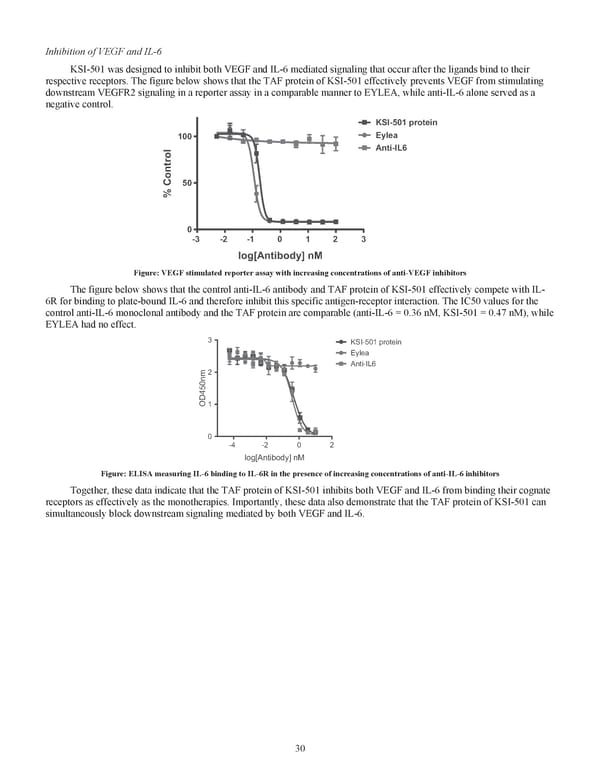
30 Inhibition of VEGF and IL-6 KSI-501 was designed to inhibit both VEGF and IL-6 mediated signaling that occur after the ligands bind to their respective receptors. The figure below shows that the TAF protein of KSI-501 effectively prevents VEGF from stimulating downstream VEGFR2 signaling in a reporter assay in a comparable manner to EYLEA, while anti-IL-6 alone served as a negative control. Figure: VEGF stimulated reporter assay with increasing concentrations of anti-VEGF inhibitors The figure below shows that the control anti-IL-6 antibody and TAF protein of KSI-501 effectively compete with IL- 6R for binding to plate-bound IL-6 and therefore inhibit this specific antigen-receptor interaction. The IC50 values for the control anti-IL-6 monoclonal antibody and the TAF protein are comparable (anti-IL-6 = 0.36 nM, KSI-501 = 0.47 nM), while EYLEA had no effect. Figure: ELISA measuring IL-6 binding to IL-6R in the presence of increasing concentrations of anti-IL-6 inhibitors Together, these data indicate that the TAF protein of KSI-501 inhibits both VEGF and IL-6 from binding their cognate receptors as effectively as the monotherapies. Importantly, these data also demonstrate that the TAF protein of KSI-501 can simultaneously block downstream signaling mediated by both VEGF and IL-6. -3 -2 -1 0 50 100 log[Antibody] nM % Control 0 1 2 3 KSI-501 protein Eylea Anti-IL6 -4 -2 0 0 1 2 3 KSI-501 protein Eylea Anti-IL6 log[Antibody] nM OD450nm 2
 Kodiak 2018 Annual Report Page 41 Page 43