
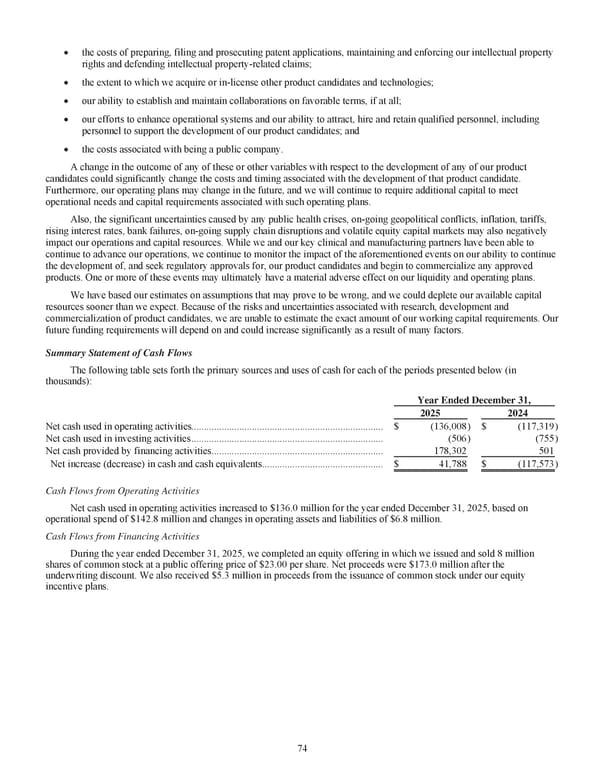
74 • the costs of preparing, filing and prosecuting patent applications, maintaining and enforcing our intellectual property rights and defending intellectual property-related claims; • the extent to which we acquire or in-license other product candidates and technologies; • our ability to establish and maintain collaborations on favorable terms, if at all; • our efforts to enhance operational systems and our ability to attract, hire and retain qualified personnel, including personnel to support the development of our product candidates; and • the costs associated with being a public company. A change in the outcome of any of these or other variables with respect to the development of any of our product candidates could significantly change the costs and timing associated with the development of that product candidate. Furthermore, our operating plans may change in the future, and we will continue to require additional capital to meet operational needs and capital requirements associated with such operating plans. Also, the significant uncertainties caused by any public health crises, on-going geopolitical conflicts, inflation, tariffs, rising interest rates, bank failures, on-going supply chain disruptions and volatile equity capital markets may also negatively impact our operations and capital resources. While we and our key clinical and manufacturing partners have been able to continue to advance our operations, we continue to monitor the impact of the aforementioned events on our ability to continue the development of, and seek regulatory approvals for, our product candidates and begin to commercialize any approved products. One or more of these events may ultimately have a material adverse effect on our liquidity and operating plans. We have based our estimates on assumptions that may prove to be wrong, and we could deplete our available capital resources sooner than we expect. Because of the risks and uncertainties associated with research, development and commercialization of product candidates, we are unable to estimate the exact amount of our working capital requirements. Our future funding requirements will depend on and could increase significantly as a result of many factors. Summary Statement of Cash Flows The following table sets forth the primary sources and uses of cash for each of the periods presented below (in thousands): Year Ended December 31, 2025 2024 ............................................................................ Net cash used in operating activities $ (136,008) $ (117,319) ............................................................................ Net cash used in investing activities (506) (755) .................................................................... Net cash provided by financing activities 178,302 501 ................................................ Net increase (decrease) in cash and cash equivalents $ 41,788 $ (117,573) Cash Flows from Operating Activities Net cash used in operating activities increased to $136.0 million for the year ended December 31, 2025, based on operational spend of $142.8 million and changes in operating assets and liabilities of $6.8 million. Cash Flows from Financing Activities During the year ended December 31, 2025, we completed an equity offering in which we issued and sold 8 million shares of common stock at a public offering price of $23.00 per share. Net proceeds were $173.0 million after the underwriting discount. We also received $5.3 million in proceeds from the issuance of common stock under our equity incentive plans.
 Kodiak Vision Sciences: Annual Report 2025 Page 85 Page 87