
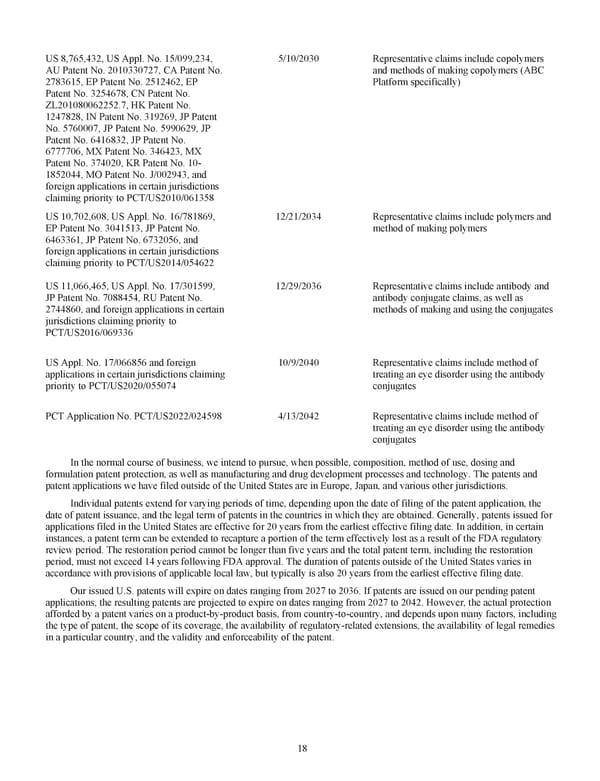
18 US 8,765,432, US Appl. No. 15/099,234, AU Patent No. 2010330727, CA Patent No. 2783615, EP Patent No. 2512462, EP Patent No. 3254678, CN Patent No. ZL201080062252.7, HK Patent No. 1247828, IN Patent No. 319269, JP Patent No. 5760007, JP Patent No. 5990629, JP Patent No. 6416832, JP Patent No. 6777706, MX Patent No. 346423, MX Patent No. 374020, KR Patent No. 10- 1852044, MO Patent No. J/002943, and foreign applications in certain jurisdictions claiming priority to PCT/US2010/061358 5/10/2030 Representative claims include copolymers and methods of making copolymers (ABC Platform specifically) US 10,702,608, US Appl. No. 16/781869, EP Patent No. 3041513, JP Patent No. 6463361, JP Patent No. 6732056, and foreign applications in certain jurisdictions claiming priority to PCT/US2014/054622 12/21/2034 Representative claims include polymers and method of making polymers US 11,066,465, US Appl. No. 17/301599, JP Patent No. 7088454, RU Patent No. 2744860, and foreign applications in certain jurisdictions claiming priority to PCT/US2016/069336 12/29/2036 Representative claims include antibody and antibody conjugate claims, as well as methods of making and using the conjugates US Appl. No. 17/066856 and foreign applications in certain jurisdictions claiming priority to PCT/US2020/055074 10/9/2040 Representative claims include method of treating an eye disorder using the antibody conjugates PCT Application No. PCT/US2022/024598 4/13/2042 Representative claims include method of treating an eye disorder using the antibody conjugates In the normal course of business, we intend to pursue, when possible, composition, method of use, dosing and formulation patent protection, as well as manufacturing and drug development processes and technology. The patents and patent applications we have filed outside of the United States are in Europe, Japan, and various other jurisdictions. Individual patents extend for varying periods of time, depending upon the date of filing of the patent application, the date of patent issuance, and the legal term of patents in the countries in which they are obtained. Generally, patents issued for applications filed in the United States are effective for 20 years from the earliest effective filing date. In addition, in certain instances, a patent term can be extended to recapture a portion of the term effectively lost as a result of the FDA regulatory review period. The restoration period cannot be longer than five years and the total patent term, including the restoration period, must not exceed 14 years following FDA approval. The duration of patents outside of the United States varies in accordance with provisions of applicable local law, but typically is also 20 years from the earliest effective filing date. Our issued U.S. patents will expire on dates ranging from 2027 to 2036. If patents are issued on our pending patent applications, the resulting patents are projected to expire on dates ranging from 2027 to 2042. However, the actual protection afforded by a patent varies on a product-by-product basis, from country-to-country, and depends upon many factors, including the type of patent, the scope of its coverage, the availability of regulatory-related extensions, the availability of legal remedies in a particular country, and the validity and enforceability of the patent.
 Kodiak Ophthalmology Medicines Company 2022 Annual Report Page 30 Page 32