
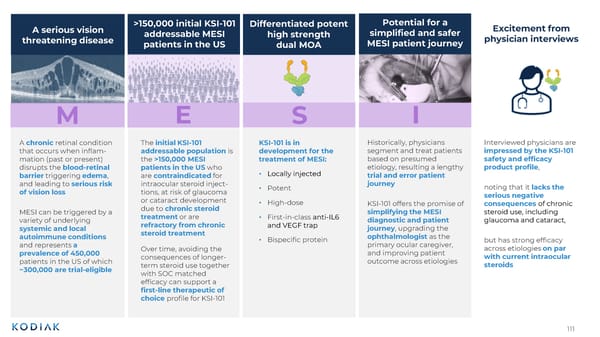
A chronic retinal condition that occurs when inflam- mation (past or present) disrupts the blood-retinal barrier triggering edema , and leading to serious risk of vision loss MESI can be triggered by a variety of underlying systemic and local autoimmune conditions and represents a prevalence of 450,000 patients in the US of which ~300,000 are trial-eligible A serious vision threatening disease The initial KSI-101 addressable population is the >150,000 MESI patients in the US who are contraindicated for intraocular steroid inject- tions, at risk of glaucoma or cataract development due to chronic steroid treatment or are refractory from chronic steroid treatment Over time, avoiding the consequences of longer- term steroid use together with SOC matched efficacy can support a first-line therapeutic of choice profile for KSI-101 >150,000 initial KSI-101 addressable MESI patients in the US KSI-101 is in development for the treatment of MESI: • Locally injected • Potent • High-dose • First-in-class anti-IL6 and VEGF trap • Bispecific protein M I Historically, physicians segment and treat patients based on presumed etiology, resulting a lengthy trial and error patient journey KSI-101 offers the promise of simplifying the MESI diagnostic and patient journey , upgrading the ophthalmologist as the primary ocular caregiver, and improving patient outcome across etiologies Differentiated potent high strength dual MOA Interviewed physicians are impressed by the KSI-101 safety and efficacy product profile , noting that it lacks the serious negative consequences of chronic steroid use, including glaucoma and cataract, but has strong efficacy across etiologies on par with current intraocular steroids E S Potential for a simplified and safer MESI patient journey I Excitement from physician interviews 111
 Investor R&D Day Presentation Page 109 Page 111